
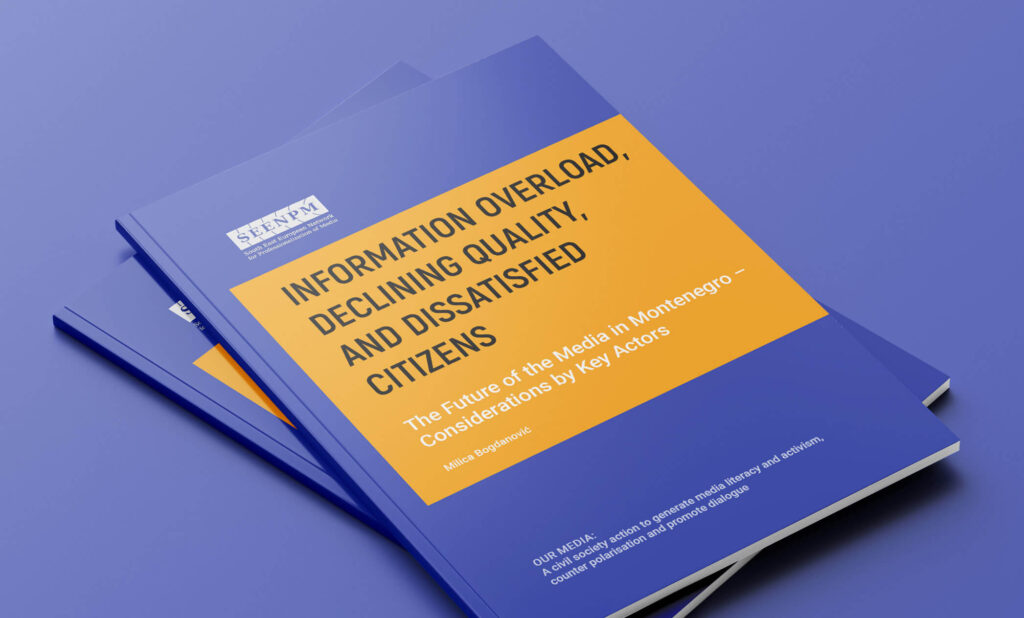
The Future of the Media in Montenegro-Condideration by Key Actors
Montenegro is facing serious anti-democratic and anti-European trends that directly affect the state of the media and journalism. Despite the formal institutional framework and adopted laws, democracy in practice remains weak, and the media landscape is confronted with numerous challenges that threaten its integrity, professionalism, and role in society. Poor working conditions for journalists, low trust in institutions and the media, and the growing influence of social networks create an environment in which traditional media are losing relevance, while at the same time providing more space for unchecked and disinformative content. These issues were also recognized by Montenegrin citizens, media professionals, and prominent individuals who contribute to the country’s cultural and intellectual development and actively participate in public discourse, and who took part in focus groups conducted by the Institute for Media in mid-2025.
Most focus group participants see democracy in Montenegro as formally present but poorly implemented in practice. In addition, most of them do not trust institutions and do not believe that civic activism can bring about change, which, in the long term, affects their motivation to participate actively in society. Participants in all four focus groups believe that professional and independent media are a prerequisite for a quality democracy in which informed and active citizens make decisions based on facts and verified information.
In addition to expressing distrust in the media and the prevailing view that they are under strong political pressure, focus group participants believe that the media tend to be sensationalist, lack full commitment to applying professional standards, and do not sufficiently engage in combating disinformation. Some citizens who participated in the focus groups, as well as most media professionals, share the view that media pluralism exists only formally, and that the increase in the number of media outlets has contributed to the wider spread of disinformation. They point out that some highly read online portals are often unregistered, which is contrary to the law, and that they do not adhere to the ethical principles of the profession.
Download publication in English and in nationallanguage.
The regional program “Our Media: A civil society action to generate media literacy and activism, counter polarisation and promote dialogue” is implemented with the financial support of the European Union by partner organizations SEENPM, Albanian Media Institute, Mediacentar Sarajevo, Press Council of Kosovo, Montenegrin Media Institute, Macedonian Institute for Media, Novi Sad School of Journalism, Peace Institute and Bianet.
This article was produced with the financial support of the European Union. Its contents are the sole responsibility of SEENPM and do not necessarily reflect the views of the European Union.
